


TikTok Business Model | How does TikTok make money?

Contents
- What is TikTok?
- Who are TikTok’s customers?
- What value does TikTok provide to its users?
- How does TikTok work?
- Who are TikTok’s key partners?
- Technology source: Unique AI algorithm
- TikTok’s key channels
- How does TikTok make money?
- TikTok’s market valuation and investors
- The future of TikTok
TikTok: The most downloaded app in the world in 2020 with the highest social media engagement rate per post. The app, which is used in over 150 countries, has over 1.1 billion users worldwide and is the fastest growing app in the world, surpassing all influential names like Youtube, Instagram and Facebook.

There’s no doubt that TikTok is making a big splash. The platform has truly created a new realm of online sharing that has revolutionized the way people connect with each other and consume digital material. With its remarkable authenticity and expanding cultural influence, this video-based social media app has made Gen Z flock to the platform.
Are you wondering what is so unique about the TikTok business model that swept the internet? How does this app work? How does it even make money when it’s completely free to use?
Don’t worry; we’ve got you covered. Let’s break down TikTok’s business model, operating model, and revenue model to find answers to our questions.
What is TikTok?
TikTok is a popular video-focused social networking platform that allows users to upload, watch, and share short video content (ranging from 15 seconds to three minutes) of various genres using their smartphones.

It is a user-friendly and creative app that creates compelling content (lip-syncing, dancing, pranks) by harnessing the imagination of its users through various challenges. The app allows its users to add audio and visual effects such as music and filters, and is known worldwide for its addictive appeal and high level of engagement, all thanks to its unique AI system.
It was founded in 2016 by Chinese company ByteDance with the mission of “creating an endless entertainment platform where anyone can contribute.” However, the platform gained a significant foothold in late 2017 when the company acquired rival app Musical.ly, which transferred its 200 million users to TikTok. And since then, it has been unstoppable. In the short span of four years, TikTok surpassed 3 billion downloads and reached one-third of all social media users on the planet.
Here is a brief timeline of Tiktok from its birth to joining the ranks of social media giants.
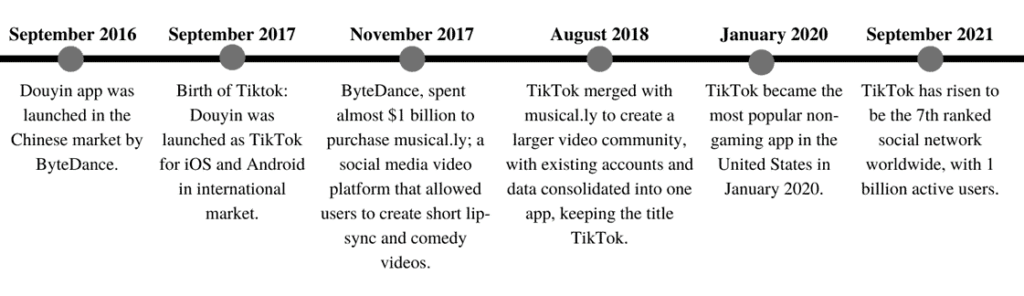
TikTok Idea
TikTok has been such a huge success because its parent company, Bytedance, recognized that people, especially Gen Z, are constantly trying new things. The platform has created a culture of trending videos, where famous artists often come up with original themed dances that TikTok users then try out, and dances that become wildly popular often become dance trends in real life. As a result, the app has completely changed the way music hits are produced and promoted.
Additionally, the app catered to a large market of consumers looking for a few minutes of micro-entertainment and distraction during the day.
However, developing a “video-based app” wasn’t an entirely new concept, as both Vines and Musical.ly were established and successful video apps with a similar idea. Their success introduced users to the concept of a video-based app, and their exit from the market served as the foundation for TikTok’s success.

Additionally, the demand for teens to leave Facebook, Instagram, and Snapchat behind and have their own social space where their parents couldn’t see what they were doing fueled the rise of TikTok. Moreover, Facebook primarily served the needs of millennials and boomers who wanted to stay connected, and Instagram helped people share their moments with their friends. However, TikTok provided a unique proposition because it understood the pent-up needs of Gen Z who wanted to be part of a community. In fact, in the first quarter of 2019 TikTok surpassed Facebook as the most downloaded social networking app in the world. It’s no surprise that despite being a relative newcomer to the social media scene, it’s a formidable contender when it comes to user acquisition and engagement. That’s because the platform has taken advantage of the declining attention spans of network users, especially among teenagers, to gain an advantage in creating viral posts.
All in all, the idea behind launching TikTok was to provide an entertaining platform for the young generation where users could express themselves freely.
Who are Tiktok’s customers?
The platform is a social hub for Gen Z. In fact, 60% of TikTok users are Gen Zers. TikTok’s primary target audience is Gen Z, the “digital natives” who crave attention and social validation. Additionally, TikTok users (consumers and creators) thrive on the platform because it allows them to express their individuality and creativity.
In addition to its users, TikTok also caters to another customer segment: advertisers. This segment uses the app extensively because the platform provides much greater efficiency than other platforms in cultivating deep audience engagement and support through user-generated content.
What value does TikTok provide to its users?
TikTok is different from any other social media platform because it is primarily an entertainment platform, not a lifestyle platform, where anyone can become a creator. It offers an interesting value proposition to all of its customer segments.
For Users
The platform allows its users to be themselves and not pretend to be in a staged environment where individuals portray the image of the life they wish to experience. That is why TikTok is a place where users can have fun, be silly, and try new things.
As for consumers, TikTok provides consumers with “tailored entertainment content” where they are shown content that they like. All of this is done with the help of its powerful algorithms. Thus, the TikTok consumer floats in their own universe of content. Unlike YouTube, which requires users to choose a video from a large number of options, users can watch their favorite videos immediately after opening the app and scrolling down to another video, saving time and energy. The short nature of its videos takes into account that Gen Z has a shorter attention span.
Likewise, for content creators, it gives anyone a chance to be discovered and even famous, something that can’t be said for YouTube or Instagram, where a creator builds an audience over months or years. The platform also has a low barrier to entry and creativity, and you don’t have to post unique content to become famous. Even simple videos that follow a given trend have a chance to go viral. The platform also provides easy-to-use augmented reality, video editing, and music features. Its live streaming feature helps content creators interact more directly with their audience; the site also allows artists to auction off their products during these streams.
Subsequently, consuming and generating content on TikTok became a seamless activity for users due to the short time to watch and create content.
For advertisers
For advertisers, running ads on TikTok can lead to a significant increase in brand engagement. Here, advertisers can directly engage influencers who match their target market demographic through the creator marketplace. The use of “challenges” is another feature of TikTok that correlates with its high engagement. Unlike other social media sites where a third party manages marketing agreements with influencers, this is a direct partnership.
Providing entertainment quotient to its consumers, social validation to creators, and incredible engagement rates for advertisers, TikTok is successfully meeting the demands of its customer segment.
How does TikTok work?

Once the app is installed, the user can immediately start exploring videos. However, if you want to upload your own video, you must first create an account by registering using an email address, phone number, or a third-party platform like Facebook, Instagram, or Twitter.
After setting up the profile, the user can navigate through the different sections of the application, which are:

- Home: Displays two feeds that the user can switch between: Following and For You.
- Discover: Displays the user’s videos that have been tagged with a popular hashtag.
- Create a video: Opens the recording screen, where the user can record a video.
- Inbox: Displays all activity on the user’s videos in one place.
- Profile: This is visible both to the user and to other users.
Here is an overview of the key activities that TikTok provides to its customers:
Explore videos
The TikTok experience revolves around videos. The user can watch an endless variety of videos ranging from comedy, gaming, DIY, food, sports, memes, pets, etc.
For you section
TikTok’s “For You” page, which acts as a homepage, is the first thing users see. Here, users can see a stream of videos tailored to their preferences, making it easier to discover new content and creators. This feed is driven by an AI recommendation system that selects a personalized feed for each user.
Next to this page is a “following” page, which displays videos from people the user follows. You’ll also find a series of icons on the right side of each TikTok video. The first takes the user to the profile of the creator who originally uploaded it. Then there’s a heart, which works similarly to hearts or likes on Instagram, followed by comments. Further down the column is an arrow pointing right to share individual TikToks to other platforms. As part of the option to share someone’s video, users can select the “React” option, which allows them to record their reaction while the video is playing and place their overlay video next to the original video. The last icon is a spinning record representing a snippet of the song the user is playing on their TikTok.


Discover section (magnifying glass icon next to the Home button)
This section allows users to search and explore a variety of content available in the TikTok community. This includes popular videos, sounds, effects, hashtags, creators, and sponsored content.


Create videos
Creators are the heart and soul of the platform. That’s why they have a range of tools available to them to customize their videos once they start recording using the plus sign at the bottom of the screen. There are a few icons on the screen, such as:
- Speed: helps capture video in slow motion or at high speed.
- Beauty: an AR filter that helps smooth their skin and hide imperfections.
- Filters: this three-circle icon at the bottom of the screen allows users to change the camera’s colour filter.
- Timer: helps set an automatic countdown for recording.
- Sounds: this icon is available in the centre of the screen and opens a music overlay or the sound effect the user wants to use.


In addition, creators can also participate in –

- Duets: This feature allows users to record a video alongside another video. It can range from actual collaborations to remixes, spoofs and so on. Users usually use this feature to promote songs and communicate with fans.

- Challenges: Also known as TikTok Trends, these essentially involve creating a video using a well-known song or hashtag. Popular tunes and hashtags such as #eyelipsface, #dontjudgemechallenge, #bottlecapchallenge, #ButHaveYouSeen and #fliptheswitch encourage users to try new dance techniques or put their own spin on the theme, thereby increasing their views or followers.

- Follow other users: To keep up with an amazing creator, users can “follow” them by clicking the icon with their profile picture and a plus sign above the heart button on their video. You can also scan their TikCode to find them. TikCode is useful for companies or individuals who want to advertise their TikTok channel on other websites or in person. Every user has their TikCode on their profile page, at the top right next to the four squares.
Who are Tiktok’s key partners?
TikTok has paid partnerships with a number of celebrities and popular influencers from various social media platforms. These celebrities and influencers create viral content and talk about the platform to their respective audiences. For example, when TikTok first launched in Japan, the platform partnered with celebrities like Yukina Kinoshita, Kyary Pamyu Pamyu, and Naomi Watanabe to attract a local audience. Similarly, Jimmy Fallon’s interest in the app grew organically, but he later monetized it through a paid relationship. Jimmy Fallon started a “challenge” segment on his show in November 2018. He challenged his followers to take the #TumbleweedChallenge and share videos of themselves rolling around like weeds on TikTok. In a week, the challenge attracted over 8,000 entries and 10.4 million engagements.


In addition to celebrity and influencer endorsements, TikTok has also partnered with marketers, who are recognized professionals who design, implement, and track advertising campaigns across a variety of specializations, such as campaign management, measurement, creative, effects, commerce, and audio.
- Campaign management partners: They help advertisers make full use of the platforms’ advertising offerings using cutting-edge technology. AdMixt, Borscht, Buzohero and Customer Acquisition are some of the agencies in this partnership.
- Measurement partners: They guide brands in analysing and measuring the overall impact of TikTok’s business solutions by providing premium services. Nielsen, Adjust and AppsFlyer are some of the measurement partners.
- Creative partners: They have the audiovisual and technological skills to help businesses create ads at scale. For example, Canva, Cooler and Airtarget are some of the leading creative partners.
- Effects partners: They know all about TikTok’s AR offerings and tools, and specialise in creating and developing augmented reality effects. Ignite XR, Genero and Byte are established effects partners of the platform.
- Commerce partners: They specialise in marketing techniques that allow merchants to effectively establish and manage their businesses. These include Shopify, Productsup and Square.
- Sound Partners: Their expertise enables brands to draw on sound and make an impact. Some of the sound partners are The Elements Music and KARM.
Technology source: Unique AI algorithm
TikTok has adopted Douyin’s sophisticated AI-based algorithm to develop and deliver its offerings. The algorithm is designed to free consumers from a multitude of video options and provide personalized recommendations that are based on a combination of factors such as:
- User interactions, such as videos users like or share, accounts they follow, comments they make, videos they add to their favourites, videos they mark as “Not interested”, videos they report as inappropriate, and the content they create.
- Video information, which is based on the content the user searches for on the Discover tab, such as captions, sounds, hashtags, effects and trending topics.
- Device and account settings, which include language preference and device type.
Additionally, the algorithm does not recommend duplicate content, videos that the user has already seen, videos marked as spam, and potentially disruptive content. The algorithm is also inclusive and does not make suggestions based on the number of followers. So, if a user creates great content that speaks directly to their target audience, they have the same chance as TikTok’s biggest stars to land on their For You page.
Key TikTok channels
The Tiktok app, available for both iOS and Android operating systems, is the primary channel through which the company provides services to its customers. The company also has a website that allows customers to explore various instructions on how to use the app, as well as the various features included in the app.
How does Tiktok make money?
According to reports, TikTok generated an estimated $1.9 billion in revenue in 2020, a 457% increase from $350 million in 2019. This was possible thanks to two main sources of revenue: ads and in-app purchases. So, let’s take a deeper look at each of these revenue streams to understand TikTok’s revenue model.
TikTok Ads
In June 2020, TikTok launched “TikTok for Business,” a new advertising option that allowed brands to promote their products on the platform through in-feed videos, brand takeovers, hashtag challenges, and brand effects.
In-feed video ads

These short videos appear between a user’s feeds while browsing the “For You” page. The unique thing is that these ads appear between videos and can take up the entire screen, similar to Instagram Stories.
Brand takeover ads

These are ads that appear right after you open a TikTok account and have the potential to make TikTok a lot of money. These ads can cost anywhere from $50,000 to $100,000 to run.
Top view ads

Unlike brand takeover ads, which appear when a user first opens an app, top-view ads appear after the user has already started using it and can last up to 60 seconds.
Branded hashtag challenges
Branded hashtag challenges are one of TikTok’s most lucrative revenue streams.
In these ads, brands create their own hashtag challenge and pay TikTok to have their brand appear on people’s discovery pages. Now, these challenges direct the user to the main challenge page where they can view detailed instructions.

TikTok charges a hefty sum for such advertising, which is $150,000 for the first six days of the hashtag challenge, plus a fee of around $100,000-$200,000 to promote the challenge (UGC).
Brand effects

TikTok also provides branded custom stickers, augmented reality filters, and lenses that consumers can use in their videos. Each branded effect can last up to 10 days, giving users ample time to connect with the brand. TikTok makes money when brands buy these ads to reach their global audience. With branded 2-D and 3-D augmented reality lenses, TikTok makes the platform more participatory and fun. Combined with a hashtag challenge, these lenses have the potential to make a campaign more engaging. TikTok allows companies to create their own lenses. These can also help users get a better idea of a product before purchasing it.
In-app purchases
Before the introduction of Tiktok for Business, the main source of revenue was in-app purchases. As part of this, creators with at least 1,000 followers can receive virtual gifts from their fans by broadcasting a live video. If users like their material, they can give them virtual gifts; however, each gift is worth a set amount of virtual coins that need to be purchased with real money through the app. With these coins, they can then send gifts to their favorite content creators. Virtual coins usually range from 100 to 10,000, with prices ranging from 99 cents to $249.99. Gifts given by followers are converted into diamonds.
Commission from content creators
When a user makes in-app purchases, the creator has the option to withdraw all the tips provided in exchange for real money. The catch is that for every dollar withdrawn from the app, TikTok takes a 50% commission and then returns the remaining amount to the TikToker’s account. Users can typically withdraw money from their account once they reach $100, with a maximum limit of $1,000 per day.
So TikTok makes money on the front end when users buy TikTok coins, and on the back end when the content creator requests a withdrawal.
Tiktok Market Valuation and Investors
In 2018, SoftBank Group Corp. led a $3 billion fundraising round for TikTok in 2018, which included KKR & Co. and General Atlantic. The funding round valued ByteDance at $75 billion.
According to recent reports, Tiger Global Management became the latest venture capital firm to invest in TikTok in March 2020. According to the Financial Times, ByteDance now has an implied value of $90 billion to $100 billion after placing its shares for sale on the aftermarket.
The future of Tiktok
TikTok’s growth has been rapid since its launch. In fact, due to its rapid popularity, Facebook introduced its own short-form video service, Lasso, in the United States in November 2018. However, only 70,000 US users had downloaded Lasso within four months of its launch, compared to nearly 40 million for TikTok.
According to forecasts released by Statista in May 2021, the number of TikTok users in the United Kingdom will reach around 15 million by 2025. The app’s popularity is likely to continue to grow, with 16.8 million users predicted by 2024. Also in May 2021, Bloomberg reported that TikTok had begun working with merchants in areas including the United Kingdom on how they could directly sell products to millions of users within the app.
Now, while TikTok’s future seems bright, the platform has always been mired in controversy, from political propaganda to conspiracy theories, lawsuits to several bans. In fact, the platform has lost millions of dollars in some lawsuits and been banned in others. With most of its data centers in China, concerns have grown and many countries like India have banned the app.. TikTok CEO Zhang Yiming has been trying to reassure governments that the app is safe and has done everything he can to clear his name of such accusations. For example, they have opened a Transparency Center for Moderation and Data Practices where experts can review their moderation policies.
Despite the platform being under investigation and facing threats, various top firms are willing to acquire its US operations. One of them is a collaboration between Microsoft and Walmart, while the other is from Oracle and may include a group of investors. This is because despite the various uproar, the platform plans to implement a turnaround and diversification strategy to overcome its current weaknesses and explore more slowly while maintaining its existing user base.
