


Thermostats for Heating Systems: Installation in Pumps, Boilers and Radiators

Contents
- Mechanical Models
- Operating Principle
- Advantages
- Installation and Its Features
- Connecting a Circulation Pump to the Mains
- Electronic Models
- Types of Thermostat
- Closed Logic
- Installing Vilo Pumps
- Open Logic
- Summary
Mechanical Models
The valve and thermostatic head are the main components of almost every thermostat. The head acts as the sensing element. These parts need no external energy to function correctly.
 Nedeštruktívne
Technoogie
ktoré nikde nekúpiš.

The thermostatic head itself has several components: a regulator and actuator, a liquid-filled element, and sometimes elastic or gas-filled parts as alternatives.
Internal Construction

When selecting a temperature controller, consider all factors that may affect its future operation. Its main parts are:
- an adjustment scale;
- a ring for securing the set temperature;
- a compensating mechanism;
- a connecting nut;
- a stem;
- a spool;
- a detachable connection;
- a sensing element;
- a thermostatic element;
- a thermostatic valve.
Operating Principle
The heating medium’s volume changes as the temperature in the heated room changes.

The bellows also changes its volume, initiating movement of the control spool. Its movement is proportional to changes in temperature conditions.
The thermostat has a special valve stem moved by a sensing element that responds to the environment.
Advantages
Temperature controllers can reduce heat-energy consumption by 10-20%. Systems with individual thermostats and additional controllers at the heat source save 25-35% of heat energy.
They also maintain a comfortable indoor climate continuously, particularly when automation controls the heat-transfer medium.
Additional Advantages
Other benefits of temperature-control devices include versatility and high precision. Their versatility lies in being suitable for installation in any type of heating system.
The equipment is used with gas, electric and solid-fuel boilers.
High adjustment accuracy means that even a mechanical device stops the supply of heated water to a radiator at the right time, let alone electronically controlled equipment.
Electronic equipment can be set to maintain a particular comfortable temperature at specific times. Electronic thermostats often offer weekly programming. Advantages also include:
- durability — the devices are made of stainless steel. Russian-made equipment is particularly interesting because its hydraulic and strength characteristics suit domestic operating conditions;
- a wide choice of brands and models — many companies now manufacture thermostats and import them from abroad. Strong competition helps lower product costs.
Installation and Its Features

A thermostatic valve is installed on the supply section of the controller’s pipework. It is important to keep the heating device’s head horizontal. Direct sunlight and substantial external heat are unacceptable.
Radiators cannot function normally when covered by curtains or furniture. This creates an area with almost no sensitivity, meaning no contact with the surrounding environment.

An Alternative

If the heating system cannot be installed differently, remote-control sensors with a sensitive contact element must be used. So-called miniature heating controllers are also designed for installation in recesses.
Specialists recommend installing a dedicated shut-off valve on the radiator return. This means the whole heating system need not be disconnected from the riser when the radiator needs cleaning or removal.

At the end of the heating season, the pump thermostat must be fully opened. This prevents excessive deposits forming on the valve seat. Simply turn the device anticlockwise.
Different types of pumping equipment can work with several temperature settings:
- summer — 28 °C;
- bathroom — 24 °C;
- living room — 20 °C;
- bedroom — 16 °C;
- internal corridor — 11 °C;
- frost protection — 7 °C.

The pump thermostat must be adjusted before active operation begins. Additional hydraulic resistance is created at this stage. Adjust the throttling mechanism smoothly to achieve the required pump-operation result.
The radiator’s return valve and inlet valve can both help achieve the same result.
Connecting a Circulation Pump to the Mains

The circuit for connecting a circulation pump to the mains is as follows.
Note. The pump wiring diagram must include either a residual-current circuit breaker with overcurrent protection, as in our diagram, or a combination of a protective circuit breaker and an RCD, a residual-current device.
This is primarily to protect people from electric shock if the pump fails or is connected incorrectly.
As you can see, the circuit is straightforward. A domestic circulation pump needs a live and neutral conductor, as well as an essential safety feature: protective earthing. The pump’s terminal box therefore contains three appropriately labelled contacts.

Most circulation pumps in heating systems use this standard connection. Its main disadvantage is that the pumps must be switched on and off manually each time, so they are often switched on at the start of the heating season and off at the end.
The disadvantages of this connection method are, I think, obvious: unnecessary energy consumption and a reduction in the pump’s operating life.
To automate a heating system’s circulation pump, reduce energy costs and increase its overall service life, it can be connected through a thermostat.
The thermostat measures the heat-transfer medium’s temperature. When it is low, the circulation pump does not switch on, avoiding needless circulation of cold water or another medium. Once the medium near the boiler reaches the required temperature, the pump starts.
Electronic Models
Also abbreviated as ET, these are automatic devices that help maintain a set temperature. They can be used with any pump type when required.

An electronic thermostat can automatically control system actuators such as valves, pumps, mixers and boilers.
How Does It Work?
An external or built-in temperature sensor is essential. It is installed away from the direct influence of other heating equipment and is used to adjust the device.

The temperature sensor provides the ET with information about ambient temperature. Digital and analogue versions are currently manufactured.
The former have more functions and have consequently become widespread.
Digital models, in turn, are divided into two types:
- with open logic;
- or closed logic.
Types of Thermostat

Mechanical Thermostat
The thermostat’s installation location and characteristics are determined when planning the heating system. Heat-supply parameters are calculated in advance, and system components are selected accordingly.
The radiator thermostat is no exception. Alongside technical characteristics, operating features must also be considered, including:
- The degree of automation… This determines how often manual adjustment is needed for normal operation;
- Installation features… Some room thermostat models can be mounted only in a precisely defined position;
- Control-element accuracy… What changes in hot-water temperature activate the device;
- Additional modes… Almost every electric heating thermostat can be configured for daily or weekly operation according to precisely defined system parameters.
Let us consider the most common thermostat types for home heating, according to their design and performance.
Some boilers have built-in thermostats. This must be considered when designing the heating system’s control mechanisms.
Mechanical Heating Thermostat

Mechanical Thermostat Construction
The simplest way to control a radiator or system section is to buy a mechanical thermostat for heating boilers, which can also be installed in radiator pipework. Its design is not particularly complicated: it contains a shut-off mechanism and a mechanical control unit.
Temperature causes the operating element, filled with working fluid, to expand. Its body presses on the stem, which lowers and restricts hot-water flow in the pipe. Reducing the effective pipe diameter reduces radiator heating.
These thermostats should be installed only after their characteristics are understood:
- Installation point. They may be fitted at either the inlet or outlet, depending on the task. To regulate radiator heating, installation is before the radiator. To restrict heat-transfer fluid leaving it, installation is after it;
- Position. For correct operation, the radiator thermostat must be mounted to the side so that hot air does not affect its control element;
- Thermostat parameters are calculated in advance for the particular heating system.
A characteristic feature of mechanical thermostats for heating boilers is their flow capacity.
The control element is adjusted before the heating system starts. Stabilise pipe pressure and set the required response value of the boiler thermostat.
Two- and Three-Way Valves

Two-Way Heating Valve
These versatile devices can perform several functions. They differ from the radiator thermostats discussed above by lacking a control element that responds to changes in water temperature.
A simple mechanical boiler thermostat operates only locally, without actually considering indoor or outdoor temperature. Automated valves do not have this drawback because of their design, comprising:
- a mechanical slide valve;
- a servo mechanism installed on the control-valve stem.
The servo can connect to any external control element, such as a programmer or temperature sensor. External data determines the valve-stem adjustment, restricting heat-transfer medium flow through that pipe section.
Besides acting as a radiator thermostat, the valves can be used in the following heating components:
- Water-Based Underfloor Heating… They form part of the mixing unit;
- Manifold Heating Systems… They regulate the supply of heat-transfer medium to a particular section.
If you need a thermostat for a heating pump, two- and three-way valves are the best choice. Besides adjusting hot-water volume, they can sometimes stabilise hydrodynamic distribution in the system.
Some valve models have a built-in temperature sensor and can also connect to an external thermometer.
Electronic Heating Thermostat

Electronic Thermostat Programmer
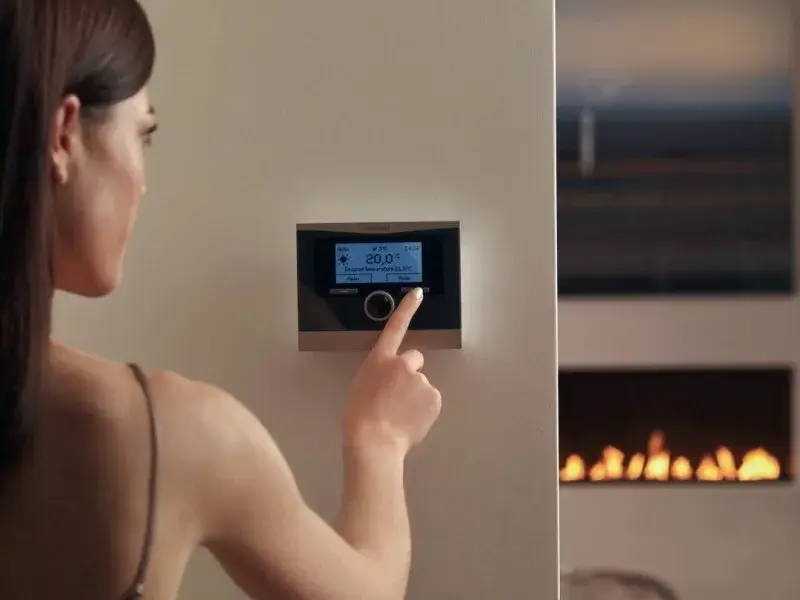
An electronic contact thermostat is recommended for automating heat supply. It is often a remote unit rather than being mounted on the radiator and can be installed anywhere in the room.
The simplest room thermostats have one remote temperature sensor and a control element installed in a particular part of the system. Its readings change boiler or control-valve parameters. For efficient operation, however, more advanced surface-mounted heating thermostats with daily or weekly programming are recommended.
Before choosing a radiator thermostat, familiarise yourself with the types:
- With a Bimetallic Coil… Exposure to warm air makes it expand and close a contact, activating the adjustment mechanism and signalling the valve to open or close. A mercury sensor performs the same function;
- With a Timer… This optional component can be configured to change heating parameters according to the time of day. Such a thermostat is suitable for heating a small house;
- Programmable… These models combine a mechanical section with an electronic control unit.
The last type of electric heating thermostat is suitable for organising an independent heat supply. It can connect to several components: a boiler, radiator servos and a circulation pump.
The heating-pump thermostat must be calibrated after installation. Actual readings from the pressure-gauge thermometer are compared with the device’s readings.
Closed Logic
Closed logic in a circulation-pump device means a fixed internal structure. The operating algorithm remains constant over time and does not change with environmental conditions.

This is entirely possible for circulation-pump equipment. Only a small number of programmable parameters can be changed.
Installing Vilo Pumps
Vilo pumps are very popular on the market today and have good technical characteristics. A wide choice of threaded and flanged connection sizes allows equipment to be selected that is ideal for an existing heating system. The radiator itself will not be involved in the work.
It is worth considering how to connect a Vilo heating pump. Installing VILO units is not difficult. A Wilo pump can be installed directly on the pipe, and various models exist. For a small floor area, up to 750 square metres, the Wilo-Star-RS model is preferable. Pumps in this series have three-speed switches and require a 230-volt supply. They can operate with working-fluid temperatures from -10 to +110 degrees, provided ambient temperature does not exceed +40 degrees.
The unit must be installed with its shaft horizontal. The terminal box has two cable outlets, allowing the Wilo heating pump to connect to power from either side. Spring-loaded terminals make the cable easy to connect.
Connecting a heating pump is therefore not difficult and can be done yourself. The main requirements are selecting the correct pump, understanding installation features and following the applicable installation rules.
Open Logic
Freely programmable instruments with open logic also exist and are often found in circulation-pump products. They can easily be configured for any environmental and temperature conditions.

However, mastering them is fairly difficult and requires special qualifications. They have therefore not become widespread, and closed logic is most commonly found in circulation equipment.
Do not economise when buying a heating-system thermostat, as it significantly increases performance and efficiency.
Summary
Radiators with thermostats allow a truly ‘smart’ heating system that adapts to changing weather. Meanwhile, radiator controllers are far from the only way to regulate heating-system operation. This material attempts to bring together existing methods of controlling domestic heating.
