


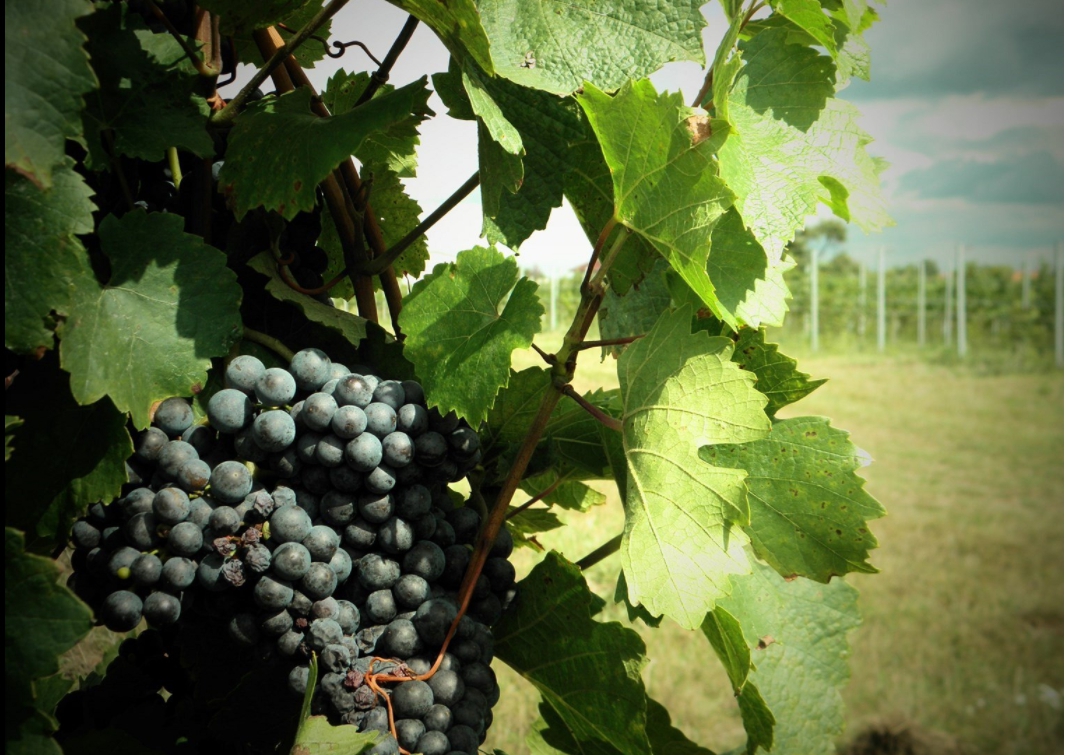
The winemaker changes weapons in the fight against starlings. Instead of alarm guns, he has scarecrows.

 Winemakers versus starlings. The eternal battle is at its peak, and a moment of inattention can decisively determine the winner. If you head out among the vineyards now, you feel as if you are in a horror film wherever you go.
Cannon shots and the calls of birds of prey, their silhouettes circling over the vineyards.
The aim is to beat the flocks of starlings at any cost before the harvest.

The “fashionable trend” of gas alarm guns was abandoned years ago by eco-winemaker Petr Čech from Tvrdonice in South Moravia. He preferred acoustic scarecrows. And also a return to the original way of farming, in which grass and trees grow between the rows of vineyards. These attract rodents and with them the best prevention of starling attacks on the valuable grape harvest: a predator.
Is the starling really enemy number one for winemakers?
Starling? That’s not so easy to say. The biggest ally and enemy of every winemaker is, first and foremost, the weather. But we can’t control that. Then there are people who can steal your entire harvest. That’s an enemy you can’t deal with so easily. The starling is a problem that can be fought. Even though it doesn’t respect any laws or borders.
Are starlings a bigger problem than various vine diseases, such as powdery mildew?
A starling can destroy your entire harvest in a very short time. If you are not prepared for it, you can lose everything in one afternoon. Powdery mildew and other vine diseases can still be dealt with if you go to the vineyard regularly. You can treat it and save it. The loss per hectare due to vine diseases is in the tens of percent, if you underestimate starlings, it is easily one hundred percent. To give you an idea, about 8 thousand kilograms of grapes for quality wine with a predicate can be harvested per hectare.
Is the starling the only animal that can negatively impact production?
Even deer in the spring. They can pick the first leaves from a young vineyard. But they are selective, they only eat certain varieties and only at certain times. From what I have here, the deer liked the leaves of the Chardonnay and Muscat varieties the most. They probably smell something.
But the starlings don’t care…
Absolutely. They take all the berries. The main problem is that they barely eat about 20% of what’s hanging on the grapes. The rest of the damage is from how they try to hold on to those bunches and they drop the other berries on the ground. And they don’t care about those anymore. A whole flock of starlings comes flying in and they fight for a place on the grapes.
How big is such a flock of starlings?
It depends on what crops are growing nearby. Corn and sunflowers near vineyards are a problem because they can hide there and make raids. Otherwise, by law, a flock of starlings, the kind that can be shot at, is considered to be over a thousand birds. You can come across a flock with a thousand, as well as with ten thousand birds.
When is it necessary to scare – the whole season?
No. We first drove starlings away here in mid-August.
What methods of scaring away starlings to protect vineyards are recommended?
Previously, a lot of work was done with various scarecrows, but the starlings soon got used to them. At one time, old CDs were placed on elevated poles. They sparkled, moved in the wind, made noise. But that didn’t work for long either.
But you can go the way of complete prevention. For example, today we can already cover the entire vineyard with a fine mesh from above, but that is quite difficult and, above all, expensive. Rather, only the part where the grapes are located is covered and wrapped with the mesh. It works, but this is a solution for small winemakers. I can’t imagine how I would cover twenty-five hectares with mesh. Where would I take the time to do it, and where would I then store it. So for larger vineyards, there are only two other technical solutions left: cannons and acoustic scarecrows.

Cannons?
Small or large cannons, which are placed either in rows or on a stand above the vineyard to echo. But I have a feeling, and I’m not alone, that the starlings will get used to the monotonous sound of the cannons sooner or later. At first, the first shot will blow them away, but after a while the flock will be together again. They will repeat it two or three times, but then you can see that they are slowly moving closer and closer. And when they find out that nothing is actually happening, they stop being afraid. It’s a matter of days before they stop being afraid completely.
How much does such a cannon cost?
Including the timer, it costs 10 to 12 thousand CZK. Depending on the location of the vineyard, whether on a hill or in a valley, you will cover 2 to 5 hectares with this. I now only use the cannons on the edges of the vineyards to help with the warning effect. Otherwise, the cannons are not very popular even among people, because the noise is really unpleasant.
Is their use restricted in any way?
Each municipality regulates this with a decree. Here, for example, it is limited to two shots per minute. But the decree no longer specifies how many of those guns we put there. And there can be, for example, ten of them, and they do not have to be synchronized. Each one can fire twice per minute, but the cannonade will be constant. It is a measure “so that the wolf is fed and the goat remains whole”. But it will not benefit anyone.
And the acoustic scarecrow?
That’s something else, the efficiency is great, high. Since I’ve had it here, I haven’t seen a starling here. But everything has its trade-offs. You have to change the gas cylinders for a cannon, the batteries for a scarecrow. There’s also a difference in the purchase price. A scarecrow costs 60 to 70 thousand CZK. But it’s been working for me here for five years, and the starlings haven’t gotten used to it yet. Otherwise, the ordinance does not restrict the scarecrow, except in terms of sound level in decibels. That’s measured 15 meters from buildings.
The sounds that are looping from that scarecrow are pretty scary. What are we hearing?
These are starling distress calls, the warning tone of an endangered starling complemented by the sound of predators.
Are trees in the vineyard a problem or not? Most winemakers get rid of them because of starlings.
I would probably say paradoxically no. It depends on what kind of trees they would be, but I think their presence can help predators to settle there or wait. That’s what I like about the organic farming system. You plant normal meadow herbs between the rows. Along with that, bees will come, which will multiply your harvest. With the grass cover, rodents will also come, which are harmless in the vineyard. And after them, as a source of food, predators will come. They then naturally repel starlings.
Are other scaring options recommended?
There are two options that I would value most in terms of efficiency: hire hunters, a guard, simply a vineyard guard with a stone, or falconers. But a falconer won’t work here for you all day, from eight to six, for eighty per hour.
The largest bird repellent shop in the EU: https://plasice.sk/
