


The Best Laser Microphones for Audio Surveillance

Contents
- Introduction
- How to Buy
- Dealerships
- FAQ
- Laser Eavesdropping Technology
- New Laser Technology Pushing Physical Limits
- Contact
- Laser Audio Surveillance Equipment
A laser microphone is a surveillance device that uses a laser beam to detect sound vibrations in a distant object. This technology can be used for eavesdropping with a minimal likelihood of detection. Laser eavesdropping.

Introduction
Without any doubt, we can state that the BEST laser eavesdropping devices in the world were developed by Israel.
Remote laser audio listening tools are completely different from some of the other ‘educational projects’ or toy devices you may find on the internet. They are the most reliable tools that law enforcement and professional surveillance teams can deploy within minutes when gaining a tactical advantage in a critical situation becomes paramount.
Laser microphones are professional laser audio surveillance tools that allow law enforcement professionals to listen covertly at a distance in any premises, using a beam of invisible light as the sound-carrying medium, without having to break into or enter the target room.
Equipped with cutting-edge technology and electronics, laser microphones are unrivalled in this field in terms of reliability, performance and ease of use. Although the limitations imposed by the laws of physics remain insurmountable, these microphones will bring you closer to those limits than ever before.
Because of the sensitive nature of the product, its high price and its operational capabilities, sales of laser eavesdropping equipment are restricted to law enforcement personnel and their authorised suppliers.
We can provide a demonstration of our equipment; however, a demonstration fee plus travel and accommodation expenses will apply.
WE DO NOT OFFER FREE DEMONSTRATIONS!
Although this is clearly stated throughout this website, many people seem unable to read. We do not work for free in the hope of completing a sale. In plain terms: we do not offer free demonstrations.
DO NOT RUSH US WITH AN END CUSTOMER!

We will ignore any request for a demonstration that has to be arranged in a hurry. If you are serious and know what you are doing, allow the necessary time. We provide some reference information about our systems on this website. If you would like to learn more, click the product links alongside.
How to Buy
To place an order, simply write to us using the contact form on the ‘Contact Us’ page of this website.
If you are a dealer or exclusive distributor, your order MUST include your dealer or exclusive distributor code so that it can be processed correctly. Credit card and PayPal payments are accepted, but surcharges apply.
Shipping charges are never included and must be added to the system price when ordering. As shipping charges may vary depending on the country and preferred shipping method, we need both your delivery address and your preferred shipping method BEFORE confirming the total order amount and collecting payment.
We ship using EMS, EU Post or DHL.
Lead times for dispatching our laser microphone models may vary.
Payment is 100% in advance by one of the following methods:
- Credit card (a surcharge applies);
- PayPal (surcharges apply);
- Wire/telegraphic transfer (our full bank details will be provided when you order).
WE DO NOT SELL TO:
AFRICAN COUNTRIES that are well-known havens for fraudsters, such as:
- NIGERIA,
- CAMEROON,
- CONGO
- and similar countries…
Dealerships
We are constantly looking for dealers and exclusive distributors WORLDWIDE.
If you are interested in becoming an exclusive distributor or simply selling our laser microphones, contact us immediately using the contact form on the ‘Contact Us’ page of this website.
International dealers are currently available for the following countries:
- ARGENTINA
- BOSNIA AND HERZEGOVINA
- CHILE
- CHINA
- CROATIA
- FRANCE
- GERMANY
- ISRAEL
- MEXICO
- NORWAY
- PAKISTAN
- POLAND
- RUSSIA
- SLOVAKIA
- SERBIA
- SINGAPORE
- SPAIN
- SWEDEN
- THAILAND
- TURKEY
- UK
- USA
If you would like to contact an official dealer in your country, we will be happy to provide your local dealer’s contact details on a need-to-know basis.
Protection against laser eavesdropping? — https://sigint.sk/
FAQ
In this section of our website, we have collected some of the most frequently asked questions about our laser microphone systems. The purpose of this page is to provide a little more information about how our laser eavesdropping equipment works and behaves, as well as about our product range.
The most frequently asked questions about our laser microphones are as follows:
- Question: How much do your laser microphones cost?
- Answer: These are not cheap items and, for those wondering, they are NOT made in China. We usually provide system quotations on a need-to-know basis, but we strongly advise potential customers to bear in mind that these are professional devices that ACTUALLY WORK, rather than toys or scientific/experimental projects. High-tech equipment is never cheap and never will be.
- Question: Is your laser microphone system easy to use?
- Answer: We could say it is fairly easy to use. However, unless you are a very experienced technician, do not expect to use it to the best of its abilities and potential the first time you take it out of its case.
- Question: Do you provide training services?
- Answer: Yes, we can train our customers to use the system correctly. However, training is not free, and the training fee must be paid in advance.
- Question: Is it possible to see a live demonstration of the system? How?
- Answer: Yes. A system demonstration can be arranged at our premises or the customer’s. Again, demonstrations are not free, and the demonstration fee must be paid in advance. The demonstration fee is not refundable against an actual system purchase, but the demonstration includes full training. Trust us when we say that you WILL need it to get the most out of our systems. If the demonstration is required at a location specified by the customer, travel and accommodation expenses must be added.
- Question: Why should I pay for a demonstration or training? Should they not be included in the price?
- Answer: Why should you work for free? Why should you accept poor pay and do work below your qualifications when you studied so hard because you wanted to be someone and build a career in life?
- Question: Do your laser microphones work on single-glazed windows?
- Answer: Certainly.
- Question: Do your laser microphones work on double-glazed windows, as well as triple-glazed and thermopane windows?
- Answer: They work on most windows in the world.
- Question: Can a laser microphone listen through walls?
- Answer: This is usually impossible for a laser microphone. However, we have found a way to make the impossible possible: the Laser D+ and M+ models are currently the only laser microphones in the world that allow this kind of performance.
- Question: How soon will I be able to master the use of a laser microphone?
- Answer: It really depends. It depends on your personal abilities and technical knowledge, as well as whether you receive training from us. Usually, if you are trained by us, you should be able to master the system after about a week of using it on your own.
- Question: How far away will I be able to listen?
- Answer: Our systems use a laser. A laser is a highly coherent light source that can travel hundreds of metres/yards through the air. The maximum operating range of our systems is approximately 400 metres/yards.
- Question: Can your system be detected?
- Answer: Yes. Although the laser beam used by our laser microphones remains invisible to the human eye, there are technical ways to detect whether a laser transmission is present.
- Question: Is your system’s laser beam affected by RF interference?
- Answer: Not at all.
- Question: Is your system’s laser beam affected by the weather?
- Answer: In general, the operation of our system is not affected by weather conditions.
- Question: Is the laser beam used by your systems safe for operators?
- Answer: The laser transmission used by our systems is completely invisible and fairly powerful. If the direct laser beam were to shine into an operator’s eyes, the consequences would be nasty. This is why we strongly advise our customers not to compromise on safety and to purchase the advanced version of our systems, which includes professional laser-resistant goggles.
Laser Eavesdropping Technology
Simplified Michaelson Interferometer
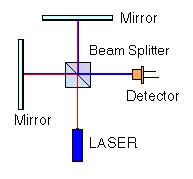
The Problem:
To detect sound remotely in a room with an exterior window.
Several methods can achieve this with a degree of fidelity; [1] however, this page describes the use of a LASER microphone.
The use of a LASER to transmit sound from a windowpane/glass is commonly shown in films, leaving the false impression that every such task is straightforward and that the LASER microphone itself is highly portable and easy to set up. My recent experience is precisely the opposite.
Angular or Grazing Detection at 45°
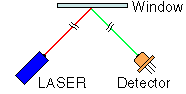
A LASER microphone can take several forms; the following examples are by no means exhaustive:
1. Probably the most intuitive is a system that grazes the LASER beam at an angle to the plane of the glass (for example, 45°), with a photodetector at the complementary angle a short distance away on the other side of the window; see Fig. 2. The principle is that sound vibrations move the window glass enough to deflect the LASER beam across the receiving photodetector.
Direct Reflection (0° Angle, Back-Reflection Detection)
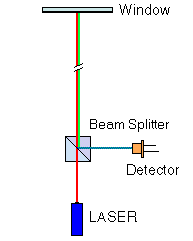
2. The second method can be the same as above, except that the LASER and detector are located together, meaning that the incident and reflected beams are boresighted.
LASER Interferometer (Michaelson)
Interferometry:
Interferometry gives you the greatest chance of success. However, it is somewhat more difficult to use. This particular approach also has several shortcomings — the most glaring (sorry) being the very large differences in ‘leg’ length. Ideally, both legs of the interferometer should be nearly the same length. This is due to temporal or longitudinal coherence, where the phase coherence of the LASER beam varies over time. If the two arriving beams are not synchronised in phase, constructive and destructive interference is degraded or absent, limiting the device’s sensitivity.
LASER Interferometer (Modified Michaelson)
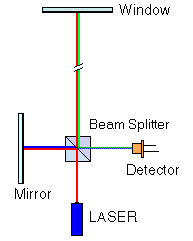
3. A third approach could use an interferometer. This takes the form shown in Fig. 5, except that one of the interferometer’s ‘arms’ is the long path to and from the window. This, of course, suffers from ‘coherence degradation’, as explained above.
Dual Beam LASER Interferometer
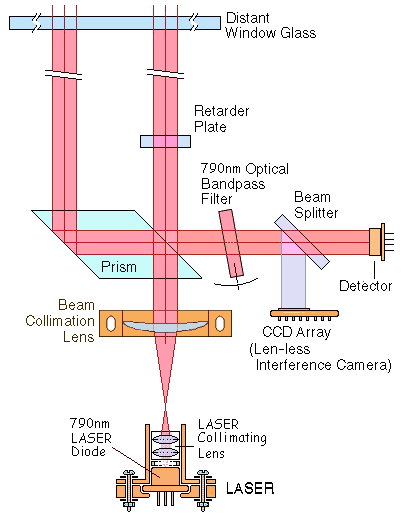
4. The final approach is an interferometer similar to the one above, but with both legs of equal length — the so-called ‘Dual Beam LASER Mic’.
The main principle is the differential measurement of glass movement (acoustic vibrations) over a small section of the windowpane.
This offers equal leg lengths for temporal coherence, common-mode rejection of large window movements, and some common-mode rejection of disturbances along the path.
Note: There is nothing magical about the LASER wavelength. The trade-off is between visible (for example, < 670 nm) and infrared (for example, > 1 500 nm). The ideal wavelength (WL) is in what is called the ‘NIR’ (near-infrared) band, for example ~ 790 nm.
Only a finite number of wavelengths are available in this band — it is a matter of physics. Cost and ease of use are often the deciding factors. Speaking of which, alignment can be a ‘bitch’ if you cannot see the beam. So, when experimenting, you may want to consider using a visible LASER!
LASER Beam Collimation, Expansion and Focusing

Some Suggested Optical Configurations
PIN Photodetector Circuit
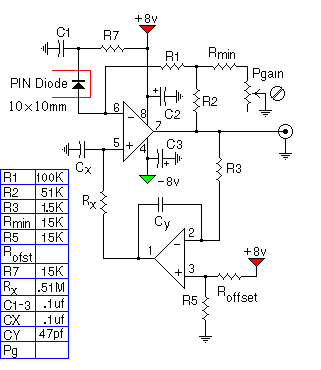
The circuit has a wide dynamic range.
The PIN diode detector can be replaced with cheaper devices.
New Laser Technology Pushing Physical Limits
A few days ago, a new model of laser eavesdropping equipment was presented outdoors at the specialist Milipol exhibition in Paris. It is used to listen in on distant offices without having to enter them.
Laser eavesdropping works on a simple principle. Sound is a mechanical wave that causes objects to vibrate when it reaches them. Laser eavesdropping can reconstruct sound from these vibrations. When someone uses a laser to listen in, they direct a laser beam at glass, most often a window behind which a conversation is taking place. The beam is modulated by the vibrations, reflected back from the window and processed by the control equipment.
‘Until now, it was understood that laser listening equipment had to be positioned at the same height as the area of interest we wanted to monitor in order to function correctly. This is because the law of reflection applies: the angle of reflection equals the angle of incidence.’
In practice, this meant that anyone who wanted to be sure they could not be monitored in this way placed their offices on the upper floors, preferably in detached buildings. ‘With the arrival of this technology, however, everything changes. The new laser audio eavesdropping equipment allows an area to be monitored through a windowpane, regardless of its position, at a distance of up to 150 metres. It can even be placed inside a car. The detailed technical solutions are known; its functionality is astonishing.’
The only reliable protection offered is the installation of a noise generator with a transducer. Resonators are attached individually to each windowpane and transmit the white noise produced by the generator. The operating principle is not to prevent the eavesdropping itself, but to create what is commonly called a noise shield, so that the acoustic vibrations cannot be converted back into the original information.

As sigint.sk noted, ‘the effectiveness of this protection must be tested very carefully. In practice, we have repeatedly encountered incorrect attachment, missing transducers at exposed locations, or completely unsuitable noise intensity settings on the generator. This makes even this form of protection completely ineffective.’
Contact — Or Protection for You? — https://sigint.sk/
Laser Audio Surveillance Equipment
A laser eavesdropping device (laser microphone) is a highly sophisticated surveillance device that uses an invisible infrared laser beam to listen in on a target. This is the world’s most effective long-range laser listening device, allowing an operator to carry out an undetectable surveillance operation on any target room with at least one window, at an impressive distance of more than 500 metres.
The laser microphone was specially developed for government and law enforcement organisations for covert use in situations where entering a building to place a listening device in the target area is unsuitable or impossible. The laser listening device is also highly difficult to detect because the infrared laser is completely invisible to the naked eye.
The laser listening device is an easy-to-assemble and easy-to-use system consisting of three main components: a laser transmitter, a laser receiver, and an amplifier and equaliser with an audio recorder. It works by directing an invisible infrared beam at the window of the target room. The laser listening device detects vibrations in the window glass caused by sound waves (speech) inside the room and transmits them back to the receiver. The laser beam reflected from the target window is then converted into electronic signals, filtered, amplified and fed into a dedicated recording unit connected to its own amplifier with a speaker and headphones. Real-time audio monitoring and recording can take place simultaneously.
Basic Laser Microphone Version, Model B-SIG
- Micrometer platform with an adjustable x/y axis (for mounting the transmitter on a professional Manfrotto tripod). One professional Manfrotto pan-and-tilt tripod is included.
- IR receiver (RX)
- Camera housing
- 500 mm telephoto lens with cable release and a special IR-reduction cover
- IR transmitter (TX)
- Camera housing
- Cable release
- 135 mm telephoto lens
- Battery with power/search-tone control panel for the transmitter (TX)
- Tools
- Amplifier and equaliser built into the case
- Cable (power supply — TX)
- RX/TX wireless headphone set
- Cable between the RX and case
- 2 audio outputs L1/L2 for a digital recorder built into the case
- Battery-slot opening tool
- Antenna for wireless headphones
Advanced Laser Microphone Version, Model A-SIG
- Micrometer platform with an adjustable x/y axis (for mounting the transmitter on a professional Manfrotto tripod). One professional Manfrotto pan-and-tilt tripod is included.
- Tools
- Amplifier with a digital noise-reduction system and equaliser built into the case
- Switching between passive and active IR modes
- Cable (power supply — TX)
- RX/TX wireless headphone set
- Cable between the RX and case
- 2 audio outputs L1/L2 for a digital recorder built into the case
- Battery-compartment opening tool
- Antenna for wireless headphones
- IR stethoscope transmitter with a 6V LI battery
OPTIONAL ACCESSORIES
- Note: A second tripod for the IR receiver (RX) and a digital recorder are not included.
- Additional standard tripod with a tilt head (height 175 cm), model AA79106-EST
- Additional professional Manfrotto tripod with a tilt head (height 188 cm), model A79106-EPT-SIG
- Aluminium carrying case with a foam insert for 2 and 2 Manfrotto micrometer platforms, model EAC-SIG
- Additional second micrometer platform with an adjustable x/y axis (mounted with the receiver on a tripod), model EMP-SIG
- Stereo (L1 + L2) digital recorder with VOX and excellent sound quality, model SDR-SIG
- Training course available at an additional charge, model TRC-SIG
We strongly recommend that clients purchase training together with the relevant system to ensure the highest level of operator proficiency. Training can be arranged at our premises or the client’s for an additional charge.
NOTICE: Sales of laser microphones are restricted to law enforcement and government agencies and their authorised suppliers — without exceptions. Laser microphones intended for export require an export licence from the United States Department of Commerce. Contact the company.
Protection against laser eavesdropping? — https://sigint.sk/
Laserski Mikrofon — Laser Microphone
Laser eavesdropping is intended primarily to provide a tactical advantage. The equipment is easily portable and takes only a few minutes to set up.
The long-range laser audio surveillance device is an ingenious unit designed for situations where it is impossible to enter a building to install a transmitter for monitoring a room. It is the most advanced laser listening device in the world and allows an operator to monitor conversations in a room from a distance of more than 450 metres.
The laser listening device uses a high-power infrared beam which, when aimed at a window, can detect tiny vibrations in the glass caused by the sound of people speaking. Using these vibrations, the device can transmit the conversation by reflecting the vibrations back along the infrared beam to the receiver, where they are filtered, amplified and fed into the device’s amplifier.
The long-range laser audio surveillance device is a highly covert surveillance system, both because of its operating range and because the infrared laser beam is completely invisible to the naked eye. To camouflage the equipment further, both the transmitter and receiver are built into standard SLR cameras, making the entire system look like photographic equipment and allowing perfect concealment.
The laser audio surveillance device is a precision unit that relies on specific alignment of the transmitter and receiver and therefore comes with sturdy tripods for both components. A three-day training course is included in the price to ensure the best possible results in any monitoring operation. Training takes place in Germany (travel and accommodation are not included). The laser listening device is supplied in a robust flight case with all necessary accessories. For full specifications, see the ‘Specifications’ tab.
A laser microphone is a surveillance device that uses a laser beam to detect sound vibrations in a distant object. This technology can be used for eavesdropping with a minimal likelihood of detection.
The object is usually inside the room where a conversation is taking place and can be anything that vibrates (such as a picture on the wall) in response to pressure waves created by noise in the room. Preferably, the object has a smooth surface. The laser beam is directed into the room through a window, reflects off the object and returns to a receiver (such as a solar panel), which converts the beam into an audio signal. The beam can also reflect off the window itself. Minute differences in the distance travelled by light reflecting from the vibrating object are detected interferometrically. The interferometer converts the variations into changes in intensity, and electronics convert these changes into signals that can be turned back into sound.
However, countermeasures exist in the form of specialised light sensors that can detect the light from the beam. Corrugated glass can be used as a defence because it provides a poor surface for a laser microphone.
By simple extrapolation, however, it should be readily possible to adapt this technique to a maser or a focused microwave beam, sending the beam through ordinary building materials and reflecting it from internal metal objects such as heating ducts or filing cabinets. At that point, the only acceptable defence is electromagnetic and acoustic isolation of the structure’s interior.
The technique of using a light beam to record sound remotely probably originated with Léon Theremin in the Soviet Union in 1947 or earlier, when he developed and used the Buran eavesdropping system. It used a low-power infrared beam (rather than a laser) to detect sound vibrations in glass windows from a distance. Lavrentiy Beria, the head of the KGB, used this Buran device to spy on the American, British and French embassies in Moscow.
The National Security Agency is reported to use laser microphones.
On 25 August 2009, US patent 7 580 533 was issued for a device that uses a laser beam and smoke or vapour to detect sound vibrations in free air (‘PSPYculate Flow Detection Microphone based on a laser–photocell pair with a moving stream of smoke or vapour in the laser beam’s path’). Acoustic pressure waves cause disturbances in the smoke, which in turn change the amount of laser light reaching the photodetector. A prototype was demonstrated at the 127th Audio Engineering Society convention in New York from 9 to 12 October 2009.
